Fantasy Map Backgrounds for Covers: Design Assets for World-Building
For designers, publishers, and content creators working in the fantasy genre, visual authenticity is not just a preference—it is a requirement. The challenge often lies in finding design assets that evoke a sense of history and geography without looking generic or overly digital. This is where the utility of Fantasy Map Backgrounds becomes evident. These are not merely decorative elements; they are foundational layers that establish the tone for a project before a single word of text is placed. When selecting assets for book covers, game packaging, or brand identity, the texture, color palette, and cartographic style of the background dictate how the audience perceives the world you are building.
Visual Characteristics and Style
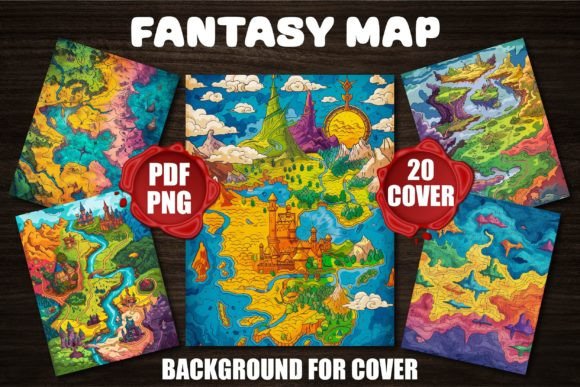
The appeal of a curated set of fantasy map backgrounds lies in their ability to transport the viewer immediately. Unlike a blank canvas, these backgrounds offer a "lived-in" aesthetic. Visually, they often mimic the tactile qualities of aged parchment, vellum, or heavy cotton paper. You will likely notice a range of tones, from the warm, sepia hues of a sun-baked explorer's journal to the cool, slate greys of a dwarven schematic. This variety is crucial for versatility; a cover for a whimsical fairy tale requires a different atmosphere than a gritty, industrial fantasy novel.
From a graphic design perspective, these backgrounds function as a sophisticated display font in their own right. Just as a serif font conveys tradition and authority, a hand-drawn map background conveys narrative depth and exploration. The visual "personality" is one of mystery and adventure. The inclusion of topographical elements—contour lines, compass roses, and mythical creature iconography—adds a layer of intricate detail that rewards close inspection. This is particularly important for packaging design, where the shelf appeal depends on the product's ability to promise a rich experience inside.
Strategic Applications for Branding and Marketing
While the most obvious application is editorial design for book covers, the utility of these assets extends far beyond publishing. For entrepreneurs and small business owners, particularly those in the tabletop gaming or niche tourism sectors, these maps can serve as a cornerstone of brand identity. A background depicting a "magical city" or "ancient ruins" can be used effectively on a website’s "About Us" page to signify the company’s journey or mission. It grounds the brand in a narrative of discovery.
Consider the power of these assets in social media graphics. In a feed dominated by flat, modern minimalist designs, a textured, richly detailed map background stands out. It offers visual complexity that captures attention. For web design, these images can be used as hero banners for landing pages, provided they are overlaid with a semi-transparent gradient to ensure the legibility of the sans serif font used for the call-to-action. The contrast between a modern, geometric typeface and an organic, hand-drawn map creates a compelling visual hierarchy that draws the eye to the key message.
Technical Quality and Creative Flexibility
A common pitfall with decorative backgrounds is low resolution, which results in pixelation when scaled for print. However, high-quality sets are provided as high-resolution PNGs at 300 dpi. This technical specification is non-negotiable for professional editorial design and print production. It ensures that the textures remain crisp even when printed on large format posters or the back cover of a paperback novel.
The creative flexibility of these assets allows for various font pairing strategies. Because the backgrounds are often busy and detailed, they pair exceptionally well with bold, clean typography. A heavy weight premium font with high x-height can cut through the visual noise of the map. Alternatively, for a more organic feel, a handwritten font or script font can be used to label specific locations on the map, integrating the text directly into the artwork. This technique is frequently used in logo design for fantasy-themed events, escape rooms, or immersive theater productions, where the text and image merge to form a single emblem.
Practical Guidance for Implementation
When integrating these backgrounds into your workflow, the primary consideration should be readability. A map background is inherently complex. To maintain a professional standard, you must manage the visual hierarchy carefully. One practical approach is to use the background at a reduced opacity or to overlay a "vignette" effect that darkens the edges, naturally guiding the viewer’s eye to the center where the title or logo resides.
Furthermore, consider the psychological impact of the specific themes. The prompt mentions "Enchanted forests" and "Mysterious castles." An enchanted forest background, with its dense, winding paths, suggests a journey that is winding and perhaps perilous, suitable for an adventure novel or a strategy game. Conversely, a map featuring "Ancient ruins" evokes a sense of history and archaeology, perfect for a mystery novel or a historical fiction blog. Matching the specific map theme to the emotional core of your project is key to cohesive brand identity.
Finally, while these assets are described as "backgrounds," they should not be treated as an afterthought. They are design assets that require the same level of curation as your primary typeface. Just as you would test a creative font across different weights and styles, you should test how the map interacts with your color palette. Sometimes, desaturating the map slightly or applying a color overlay (such as a deep navy or forest green) can help it harmonize with the rest of your web design or print layout, ensuring it supports rather than overwhelms the content.