Enchanting Mushroom Island Backgrounds for Book Covers
There's a distinct moment when you're browsing a bookshelf—digital or physical—and a cover stops you cold. It’s not always the typography or the title, but the world the cover promises. For projects that lean into fantasy, whimsy, or a sense of serene exploration, that world is often built through the background. This is where a focused asset like the Mushroom Island Backgrounds for Cover collection moves from a nice-to-have to a central design tool. It’s not just a set of pretty pictures; it’s a curated environment for your story to live in.
More Than a Backdrop: Defining the Visual Personality
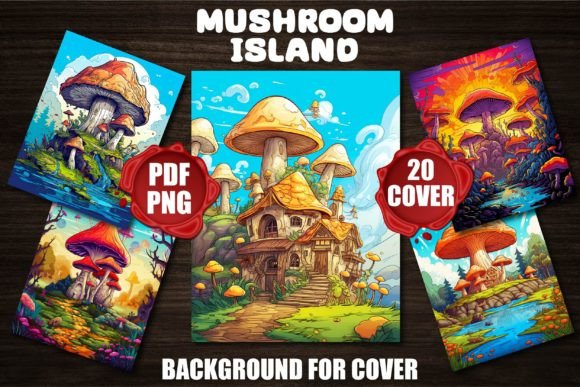
Let's be specific about what you're getting. This isn't a generic forest or a standard mountain range. A mushroom island carries a very specific visual personality. Think about the core elements: the organic, rounded forms of oversized fungi, the soft glow of bioluminescence, the dense, textured foliage, and a sense of scale that feels both miniature and expansive. The style here leans into a whimsical and fantastical aesthetic, but it’s rendered with a level of detail and color theory that grounds it. The appeal is in the balance—it’s magical without being childish, intricate without being chaotic. This gives it a versatility that a more aggressively "cute" or "dark" fantasy style might lack. The overall mood is one of enchanted discovery, making it ideal for narratives that blend wonder with a touch of mystery.
Strategic Applications for Creators and Entrepreneurs
Knowing what it looks like is one thing. Knowing where it works is where the real value lies. As a designer or publisher, your goal is to match the asset to the project's needs and audience expectations. Here’s a practical breakdown of where these backgrounds excel.
- Publishing & KDP Direct: This is the most direct application. For a coloring book for adults, these backgrounds serve a dual purpose. They can be the cover design itself, setting a clear thematic expectation for the interior's intricate designs meant for stress relief and art therapy. Alternatively, they can be used as a thematic backdrop for the title, creating cohesion between the cover and the KDP interior pages. The high resolution at 300 DPI is non-negotiable here, ensuring crisp print quality for Amazon Kindle Direct Publishing.
- Digital Branding & Marketing: For a brand in the wellness, mindfulness, or creative space, these backgrounds can become a core part of the visual hierarchy. Use them as a textured, immersive background for your website's hero section, as a scene for product mockups on social media, or as the foundation for quote graphics. The brand identity you build is one of creativity, calm, and imagination. It’s a strong signal to your audience about what you value.
- Product & Packaging Design: Imagine a tea company specializing in herbal blends, a stationery brand, or a small-batch candle maker. Using a Mushroom Island background on packaging or a product label instantly communicates a story. It says, "This product is crafted with imagination, inspired by nature, and offers an experience." This moves your design from purely functional to evocative, which is key for shelf appeal and brand recognition.
- Personal & Craft Projects: The utility extends beyond commercial use. For journalers, planners, and crafters, these backgrounds offer a way to personalize a space. They can be printed as inserts, used as a base for digital planning stickers, or incorporated into mixed-media art projects. The creative expression is in how you layer your own text, illustrations, or photos over these richly detailed scenes.
Integrating the Asset: Practical Design Considerations
A beautiful asset can fall flat with poor integration. Here’s how to think about using these backgrounds effectively to enhance, not overwhelm, your project.
Typography Pairing is Critical: The background is detailed. Your typeface needs to be legible against it. This is less about finding a "matching" font and more about creating contrast. A clean, bold sans serif font often works well, providing a modern, readable counterpoint to the organic background. A elegant serif font can add a touch of classic fantasy. Avoid overly ornate script fonts or handwritten fonts with thin strokes, as they can get lost in the background texture. Test your font pairing on a few different backgrounds from the set to see how it performs.
Creating Visual Hierarchy: Your title and author name are the primary focal points. Use the background to support them, not compete. Techniques like adding a subtle, semi-transparent overlay (a dark vignette or a light mist) behind the text can dramatically improve readability. Alternatively, use the background to frame your text, perhaps by placing the title in a less visually "busy" area of the composition, like an open sky or a calm patch of water.
Color and Mood Consistency: The collection likely offers a range of color palettes within the mushroom island theme—some more vibrant and daylight-oriented, others more muted and twilight-focused. Choose a background that aligns with the emotional tone of your project. A coloring book focused on mindfulness and relaxation might benefit from a softer, dusk-like scene, while a fantasy adventure novel might use a more saturated, sun-dappled forest. This consistency strengthens the overall professionalism of the design.
Licensing and Final Checks: Before you finalize, always review the included license for the design assets. Confirm it covers your intended use—whether for a digital print product, a massive bundle design for sale, or a single commercial project. The note that these are AI-generated is worth acknowledging; it means the imagery is unique, but also that you should review each file to ensure it meets your quality standards and doesn't contain any unintended artifacts. The inclusion of 20 PNG files gives you a solid variety to work with, allowing you to maintain a cohesive look across a series or select the perfect single image for a standalone project.
Ultimately, the Mushroom Island Backgrounds for Cover collection is a specialized tool for a specific creative vision. It solves the problem of "where do I find a consistent, high-quality, thematic backdrop for my fantasy or whimsical project?" By understanding its visual personality, applying it to the right contexts, and integrating it with thoughtful design principles, you can transform it from a simple background into the foundation of a compelling visual story.